
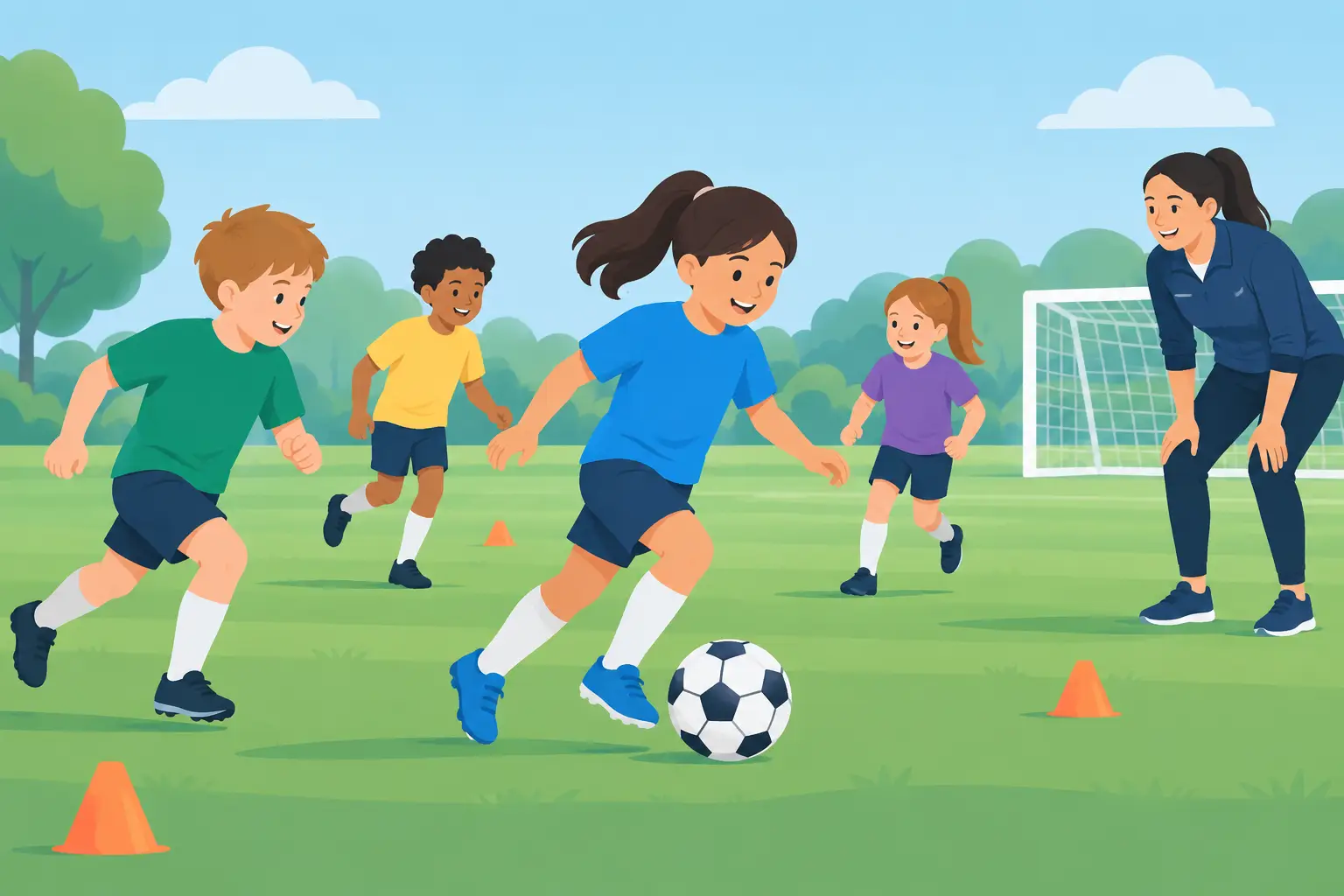
A child does not need to be the fastest runner, score the most goals or know the rules of football to enjoy their first class. Non competitive football classes for children give little ones space to kick, run, listen, laugh and try again, without feeling that they have to prove themselves. For many families, that makes all the difference.
At this age, football is not really about tactics or league tables. It is about learning what happens when your child joins a group, waits for a turn, follows a simple instruction and hears, “Well done, have another go.” Those small moments can build confidence that reaches far beyond the pitch.
What makes a football class non-competitive?
A non-competitive class still has plenty of energy. Children may practise dribbling around cones, stopping the ball, aiming at a goal or joining in a playful team challenge. The difference is in the purpose. Activities are designed for participation and development, rather than selecting the strongest players or focusing on who won.
For children aged 18 months to 6 years, this approach is often a much better fit than formal football. Their coordination is still developing, their attention can come and go, and sharing equipment can feel like a big task. A good coach meets them where they are, using games, repetition and encouragement to help them feel comfortable.
That does not mean children never experience a challenge. They do. They might be asked to balance, jump, kick with a different foot or work with another child. But the challenge is age-appropriate, and the success is in trying, improving and being part of the group.
Why pressure-free football helps young children grow
Early-years sport can support many of the skills parents hope their child will gain before school. Football happens to be a particularly engaging way to practise them because there is a ball to chase, a target to aim for and other children to play alongside.
Confidence grows through small wins
Some children walk into their first class ready to charge towards the football. Others prefer to watch from the side, hold a parent’s hand or take several weeks to join in fully. Both responses are completely normal.
In a supportive class, there is no spotlight on the child who needs more time. Qualified coaches use gentle encouragement and clear routines, celebrating every step forward. That might be rolling a ball for the first time, joining a warm-up or saying hello to a new friend. When children feel safe to try without fear of getting it wrong, their confidence has room to grow.
Coordination develops through play
Kicking a moving ball looks simple to adults, but it asks young children to balance, judge distance, move their legs and keep track of where the ball is going. Add running, stopping, jumping and changing direction, and football becomes a brilliant whole-body activity.
Play-led sessions can help children develop gross motor skills at their own pace. The goal is not a perfect kick. It is steady progress, better body awareness and the pride that comes with doing something they could not quite manage last week.
Listening and group skills get a gentle workout
A football class gives children regular chances to hear and respond to simple instructions: stop, go, find a colour, put the ball on your foot, wait for your turn. These are useful skills for nursery, reception and everyday family life.
They also learn that a group activity involves other people. Sometimes they will have the ball; sometimes they will watch a friend have a turn. With patient coaching, children begin to understand sharing, cheering each other on and playing side by side. Where Team Mates become Best Mates is more than a nice phrase – friendships often start with a shared giggle over a runaway football.
Who are non-competitive football classes for?
They are for the child who already sleeps with a football by the bed, and for the child who has never kicked one before. They suit families who love football and want an age-appropriate introduction, as well as parents who simply want a local activity that gets their little one moving and meeting others.
They can be especially helpful for children who are building confidence in group settings. A familiar weekly routine, a welcoming coach and a manageable class structure can make joining in feel less daunting. However, every child is different. A very busy class may still feel overwhelming for some children, while others may be ready for more challenge sooner. A free trial is a useful way to see how your child responds without pressure.
Parents should not worry if their child does not join every game straight away. Watching is often part of learning. A coach who understands early-years development will offer invitations rather than demands, allowing children to take part in a way that feels safe.
What to look for in a children’s football class
The best class is not necessarily the one promising future academy players. For this age group, look for an experience that feels organised, warm and realistic about what young children need.
First, check that coaches are qualified to work with children and DBS-checked. Safeguarding, clear supervision and a child-friendly environment should never be extras. It also helps when coaches can explain the purpose behind activities, whether that is coordination, listening, confidence or social play.
Next, consider the structure. Young children benefit from a predictable session with short activities, clear transitions and plenty of movement. Long queues and complicated drills can quickly lose their attention. A playful approach keeps football enjoyable while still giving each child repeated chances to practise.
Finally, ask practical questions. Is there a trial class? Are age groups appropriate? What is included in membership? Can you cancel if the class is not right for your family? Clear answers make it easier to choose with confidence.
A first session: what parents can expect
A good first class should feel welcoming, not like an assessment. Your child may be greeted by name, introduced to the coach and shown where to put their things. Sessions usually begin with an energetic warm-up before moving into simple football games and a calm finish.
Bring comfortable clothes, suitable footwear and a water bottle if one is not provided. More importantly, bring realistic expectations. Your child might join in from the first minute, or they might spend much of the session close to you. Neither is a failure. Familiarity often changes everything by the second or third visit.
At Star Kicks, families can try a local class before committing to membership. Once enrolled, children attend weekly sessions and can enjoy progress tracking alongside their football kit, ball, backpack and water bottle. It gives young players a sense of belonging from the start, while parents have a straightforward monthly arrangement with flexible cancellation.
When is a child ready for more competition?
There is no single age or moment when a child should move into competitive football. Readiness is less about ability and more about enjoyment, emotional maturity and choice. A child who loves taking part, can cope with small disappointments and asks for more challenge may be ready to try a friendly match or a more structured team setting.
Even then, fun should remain the foundation. Competition can teach resilience and teamwork when introduced thoughtfully, but too much pressure too soon can make children associate sport with worry rather than joy. Many children thrive for years in non-competitive sessions, developing the skills and self-belief that make any later transition feel natural.
The most valuable first goal is not the one that hits the net. It is the moment your child leaves smiling, tells you about the game they played and looks forward to seeing their new friends next week.