
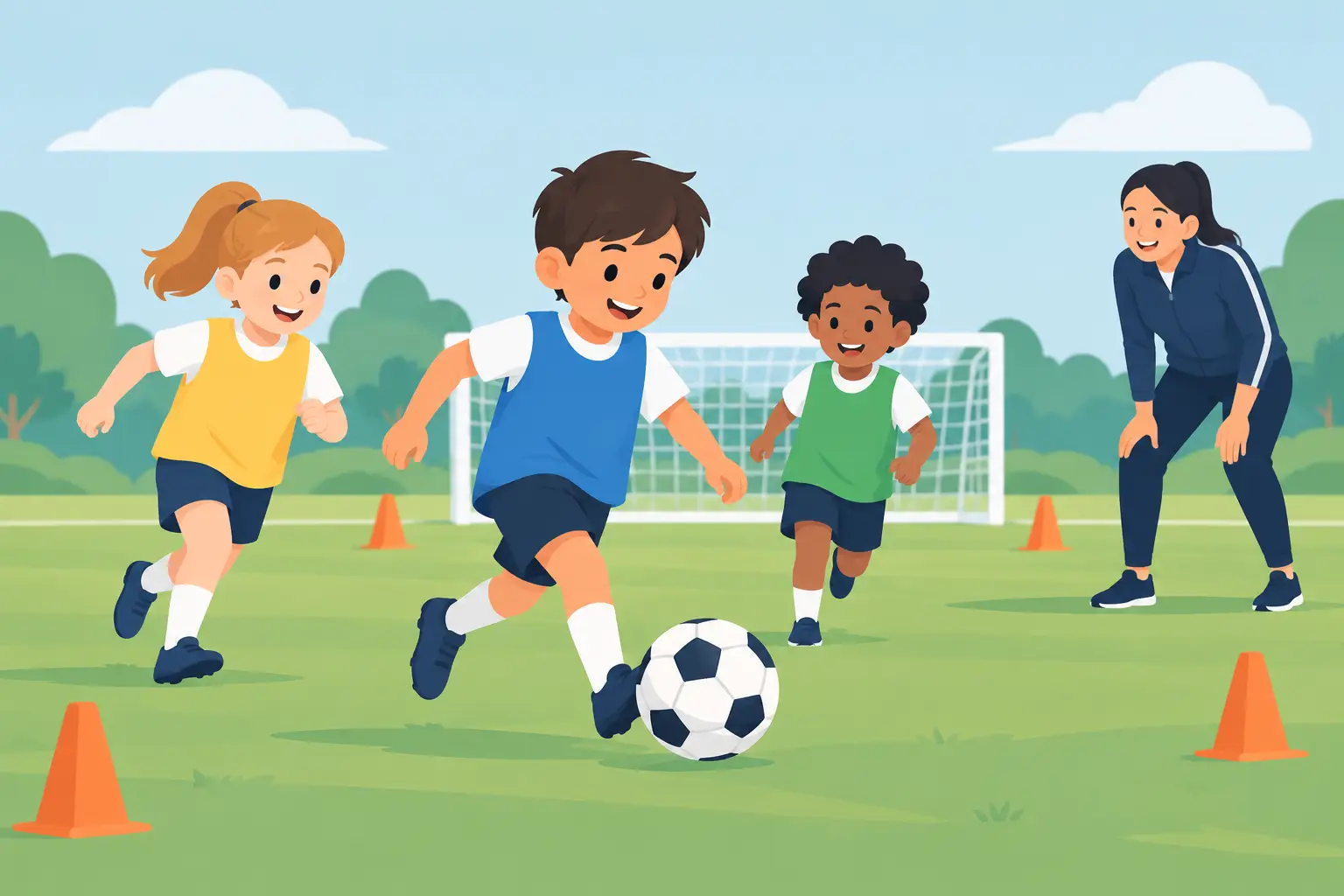
A toddler may not remember the name of every football skill, but they will remember the feeling of hearing their name cheered, high-fiving a new friend and scoring a goal of their own. That is why play based football for young children is about far more than learning to kick a ball. It gives little ones a happy, supported place to move, listen, explore and grow alongside other children.
For parents, it can be a gentle first step into group activities. For children, it can be the start of a real sense of belonging – where team mates become best mates.
What does play based football mean?
Play based football uses simple games, stories and challenges to introduce football skills in a way that makes sense to young children. Rather than asking a two-year-old to practise a drill repeatedly, a coach might invite them to dribble their ball through a jungle, knock down colourful cones or race to rescue a teddy.
The football is real, but the learning is wrapped in play. Children practise stopping, starting, turning, kicking and balancing without feeling as though they are being tested. They are busy having fun, while building the foundations that will help them at nursery, school and in everyday life.
This does not mean classes are unstructured or chaotic. The best early-years sessions have a clear, age-appropriate plan. There are familiar routines, short activities, kind boundaries and plenty of encouragement. Young children feel safer when they know what comes next, even when the game itself is wonderfully imaginative.
Why play based football for young children matters
Early childhood is a busy time for development. Between 18 months and six years old, children are learning how their bodies move, how to communicate their needs and how to be part of a group. A well-run football class can support all of this while giving them a positive relationship with physical activity.
Confidence grows one small win at a time
For a child who is naturally cautious, joining a group can feel like a big challenge. They may prefer to watch at first, hold a parent’s hand or keep their ball close by. That is completely normal.
A nurturing coach gives each child time and celebrates the small steps: joining the warm-up, kicking towards a target, answering a question or taking turns with another child. These moments add up. Over time, a child who once stood at the edge of the activity may be racing into the next game with a huge smile.
Confidence is not about being the loudest or fastest. It is about feeling secure enough to have a go.
Coordination develops through purposeful movement
Football naturally encourages children to use both feet, judge distance, change direction and coordinate their eyes with their movements. Simple games can develop balance, agility and body awareness without asking young children to understand technical coaching language.
At this age, progress rarely looks like perfect ball control. It may look like a child lifting their head while dribbling, managing to stop the ball with their foot, or moving confidently through a space without bumping into others. Those are meaningful milestones.
Every child develops at a different pace, so comparison is not helpful. The aim is to give each child regular chances to practise movement in a way that feels achievable and exciting.
Listening and following instructions become part of the fun
“Can you find a blue cone?” “Freeze when the coach says stop.” “Which foot will you use next?” Playful prompts help children develop listening skills without sitting still for long periods.
Early-years football works best when instructions are short, clear and repeated through routines. Children begin to understand taking turns, waiting briefly, responding to a whistle or signal, and following a simple sequence. These skills can help them feel more confident in nursery, reception and other group settings too.
There will be wobbly moments, especially with younger children. A child may become distracted, need a cuddle or decide that a puddle is more interesting than the next activity. A good coach responds calmly and brings them back into the game without shame or pressure.
Friendship without the pressure
Young children do not need to arrive with a best friend to enjoy football. Shared play makes it easier to connect. Passing a ball, celebrating a goal or working together in a simple team game creates natural chances for conversation and laughter.
These first social experiences are valuable because they are low pressure. Nobody has to be picked as the best player. Nobody needs to understand league tables or competitive tactics. Instead, children learn that it feels good to encourage someone else, share space and be part of a friendly group.
Some children make friends quickly. Others take several weeks to feel comfortable. Both are fine. Regular weekly sessions can make a real difference because familiar faces, coaches and routines gradually turn a new place into their place.
What a great early-years football class should look like
Parents do not need football knowledge to choose the right class. Watch how your child is welcomed and how the coach responds to the group. The atmosphere should feel upbeat, safe and inclusive, not intimidating or overly serious.
Look for qualified, DBS-checked coaches who understand how young children learn. They should use clear language, adapt activities when needed and notice the child who needs a little extra reassurance as well as the child who is ready for the next challenge.
A strong session usually includes movement from the start, a warm welcome, simple ball activities and a calm finish. Equipment should be child-friendly, with appropriately sized footballs and enough space for children to move safely. Parents should also understand how the class is organised, what membership includes and who to speak to if they have a question.
At Star Kicks, sessions are designed around those early developmental wins: confidence, coordination, listening, social play and a genuine love of being active. The goal is never to create pressure around performance. It is to help children enjoy showing up, having a go and feeling proud of themselves.
Is it right for every child?
Play-led football can suit energetic children who want to run straight in, but it is equally valuable for children who take time to warm up. The key is finding a class that respects their stage of development and does not expect too much too soon.
It may not be the right fit on every day. A tired toddler after nursery, a child going through a shy patch or a family with a busy routine may need flexibility. That is why a free trial can be so useful. It lets your child experience the coach, space and group before you commit.
For children who are not especially interested in football, the playful format may still appeal. They might come for the games, songs, colourful equipment or friendships, then gradually discover that they enjoy kicking a ball too. Equally, a football-mad child benefits from learning that sport is about sharing, listening and enjoying the team, not simply scoring goals.
Helping your child get the most from their first class
Keep expectations light. Tell your child they are going to play some football games, meet a friendly coach and have a go. Avoid promising that they will score, make a friend or join in every activity straight away.
Arrive with enough time for a relaxed start, and choose comfortable clothes they can move in. If parents are invited to stay close for younger groups, your calm encouragement can help. Try simple phrases such as, “You can have a go when you’re ready,” or, “I liked how you listened to the coach.”
Afterwards, ask about the fun rather than the result. “What was your favourite game?” often opens up more than “Did you score?” It shows children that enjoyment, effort and kindness matter.
The right first football experience should leave your child feeling a little taller, a little braver and excited to return. Give them the space to play, and they may surprise you with everything they learn along the way.