
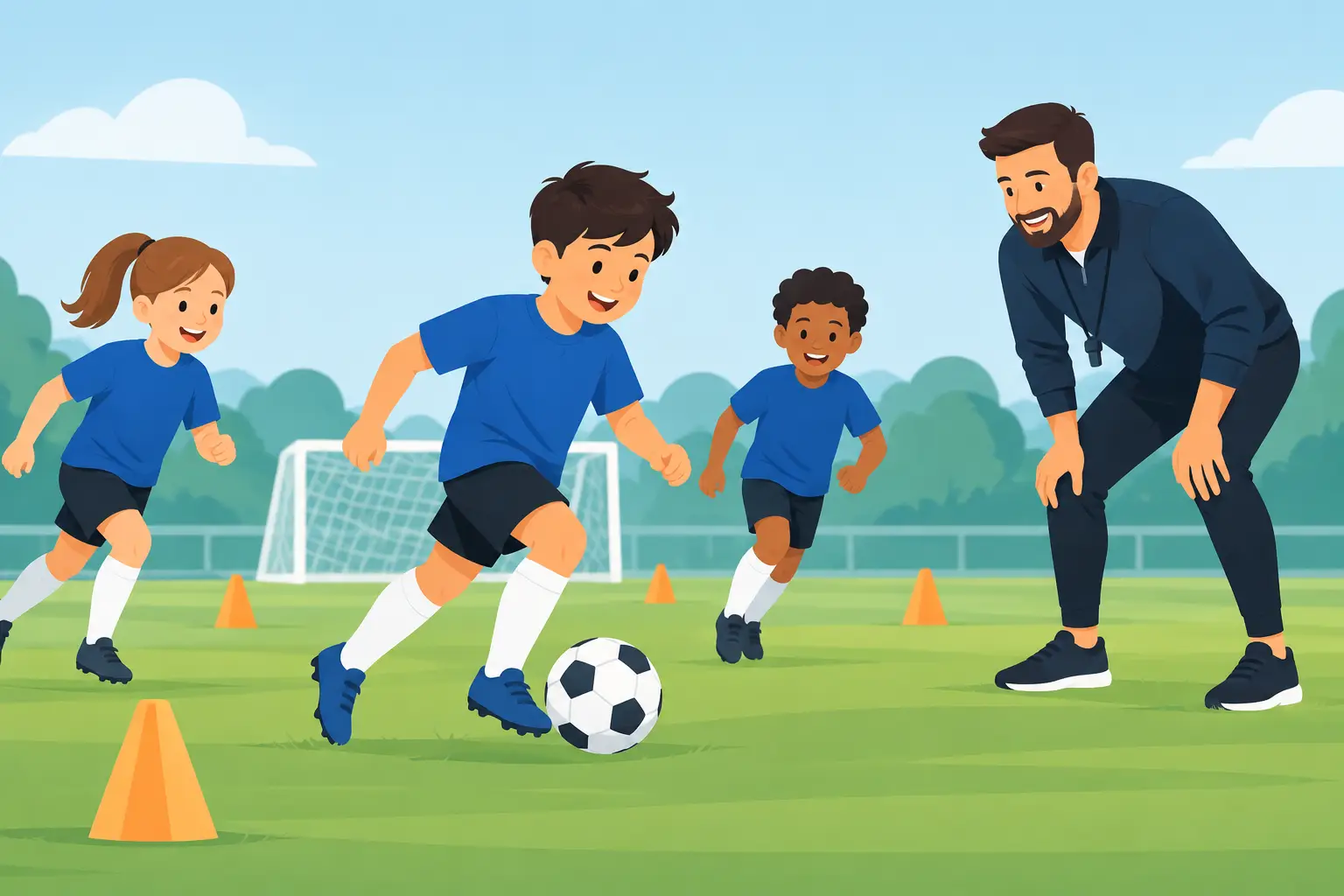
A first football class can look like a collection of small moments: your child stopping a ball with two feet, waiting for their turn, joining a game with a new friend or proudly telling you they scored a goal. For little ones, football coaching for beginners is not about perfect passing or picking the strongest team. It is about finding a happy, supported place to move, listen, play and grow.
For parents, that distinction matters. Children aged 18 months to 6 years are still learning how to be part of a group, how their bodies move and what it feels like to try something unfamiliar. The right class meets them there – with smiles, simple activities and plenty of encouragement.
What beginners really gain from football
Early-years football is about far more than kicking a ball. A well-planned session gives children repeated, playful chances to practise skills that support everyday life, at nursery, at school and at home.
Running, balancing, hopping and changing direction help develop coordination and body awareness. Dribbling a ball around cones encourages control and concentration. Catching, rolling and stopping the ball build hand-eye and foot-eye coordination without making children feel as though they are doing drills.
There is a social side too. Young children learn to follow a coach’s instruction, share equipment, take turns and celebrate another child’s success. Some will race into the room ready to play. Others may prefer to watch first, stay close to a parent or need a little extra time before joining in. Both responses are completely normal.
A nurturing coach creates space for every child to take part at their own pace. Over a few weeks, the child who first held back may start carrying the ball, joining the warm-up or calling out the answer to a question. Those small wins can make a big difference to confidence.
What football coaching for beginners should look like
For this age group, a good class should feel organised without feeling strict. Children need a predictable routine, but they also need games that are lively, imaginative and short enough to hold their attention.
A session may begin with a friendly welcome and simple movement game, then move into ball activities designed around one clear skill. A coach might turn dribbling into an adventure, ask children to keep their ball away from a playful “shark”, or use colours and pictures to make listening games more exciting. The session should finish with praise, a calm ending and a sense that every child has achieved something.
The activities will vary by age. An 18-month-old may be learning to roll, chase and stop a ball, often alongside their parent or carer. A four- or five-year-old may be ready to dribble with more purpose, practise simple passes and work with a partner. Neither stage needs pressure. Development is not a race, and children progress differently.
The best coaches adapt rather than expect every child to perform the same task in the same way. If one child is practising a gentle kick while another is ready for a challenge, both should leave feeling successful.
Choosing a class your child will enjoy
It is easy to assume that football is only for children who already love the game. In reality, a first class is often a great fit for children who simply enjoy moving, playing games or being around other little ones. You do not need to know the rules of football, and your child does not need previous experience.
When looking for a local class, focus on the experience around the football as much as the football itself. Four things are particularly worth checking:
- Coaches should be qualified, DBS-checked and comfortable working with young children.
- Classes should be designed for specific age ranges, with activities suited to early development.
- The group should feel welcoming, with no pressure to compete or prove ability.
- Parents should understand how booking, membership and cancellation work before committing.
A free trial can be especially helpful. It lets your child experience the coach, the group and the environment before you make a decision. It also gives you a chance to see whether the class feels calm, safe and genuinely enjoyable.
Look beyond whether your child joins every activity on their first visit. A successful first session might mean they carry a ball, copy one movement, wave goodbye to the coach or say they would like to come back. Those are all promising signs.
How to help before the first session
Keep preparation simple. Comfortable clothes, trainers and a drink are usually enough. If your child receives a kit or their own football as part of joining, it can make the experience feel extra special, but there is no need to spend weeks practising beforehand.
Talk positively about what will happen. You might say, “There will be balls, games and a coach who will show you what to do.” Avoid promising that they will score goals or make a best friend straight away. Young children respond better when there is room to discover the experience for themselves.
Arriving a few minutes early can help if your child is cautious in new places. They can see the space, watch other children and settle before the session begins. If the class allows parents or carers to stay nearby, your calm presence can provide reassurance without taking over.
It is also useful to give your child a simple choice, such as whether they would like to carry their water bottle or wear their favourite socks. A little ownership can help a big new activity feel manageable.
Confidence grows through repetition
Parents sometimes worry when their child does not immediately join in, listen all the time or use the ball in the expected way. At this age, learning can look wonderfully messy. A child may run after the wrong ball, sit down halfway through a game or want to repeat the same kick again and again.
What matters is the coaching response. Warm encouragement, clear boundaries and simple instructions help children return to the activity without feeling told off or left behind. Over time, familiar songs, routines and games build security. Children begin to understand what comes next, which makes it easier to try more.
This is why regular attendance can be so valuable. Weekly classes give children time to recognise faces, remember routines and build relationships. They are not starting from scratch each time. The football skills improve, but so do listening, resilience and confidence in a group.
At Star Kicks, the aim is to create that kind of positive first sporting experience: a place where team mates can become best mates, and children can enjoy learning without the weight of expectation.
Progress is more than goals and medals
For beginners, progress is often quieter than parents expect. It may be a child who used to cling to your hand now walking in independently. It may be a child who learns to wait while another player has a turn, or who keeps trying after missing the ball.
Physical skills matter, of course. Children may become more confident with dribbling, stopping, kicking and moving around others safely. But the wider milestones deserve just as much celebration. Being kind, listening to a coach, joining a circle and saying “well done” to a friend are all part of becoming a happy team player.
If a class offers progress tracking, use it as a conversation starter rather than a scorecard. Ask your child what game they liked, who they played with or what they found tricky. Their answers can tell you far more about how they are feeling than a tick next to a skill.
When is the right time to start?
There is no single perfect age. Some toddlers are ready to explore a group activity from 18 months, particularly with a parent or carer close by. Others may enjoy it more once they are a little older and comfortable following short instructions. It depends on your child’s temperament, their experience of groups and the structure of the class.
If your child is energetic, shy, football-mad or unsure around new people, there can still be a place for them. The key is choosing a session that treats beginners as beginners – with patient coaching, age-appropriate games and success measured in smiles as well as skills.
A good first football class should leave your child feeling taller than when they arrived, whether that is because they kicked the ball, joined a game or simply had the courage to step onto the pitch. That is a brilliant place for their football story to begin.